
Founder-Led Outbound: DIY, Hire, or Let AI Operate It
Key takeaways
- Nearly every founder eventually wants to hand outbound to someone else, but experienced operators repeatedly warn against doing that before a repeatable process exists.
- There is no single revenue number that tells a founder when to stop founder-led selling. Different operators point to different triggers, including revenue, capacity, and repeatability.
- Experts also disagree on who to hire first. Some recommend an SDR focused on prospecting, while others argue the first hire should be an Account Executive who can own a deal end to end.
- A strong record of hitting quota inside a mature company does not automatically prove someone can build an early-stage sales playbook from scratch.
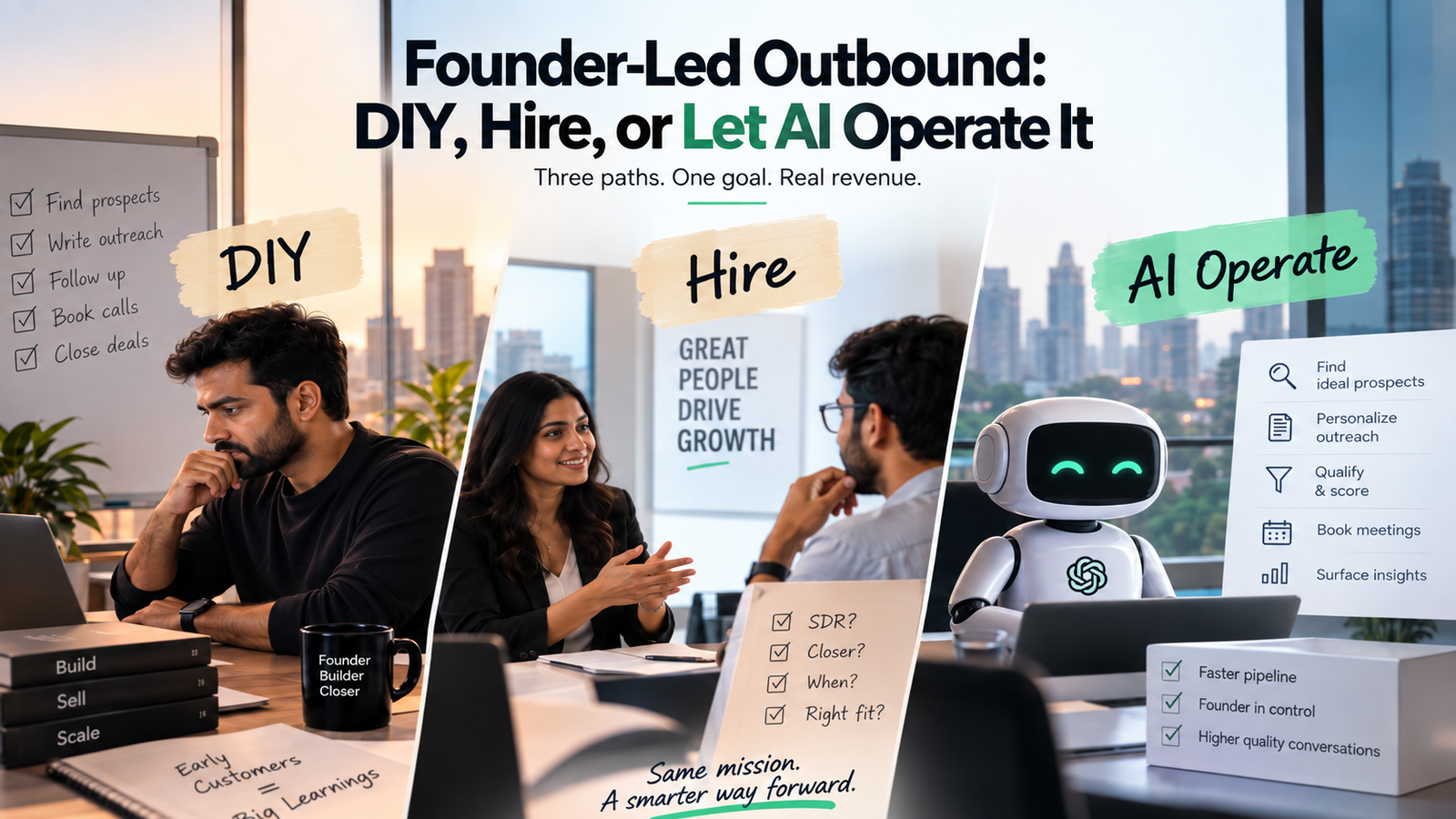
- An AI-operated qualification layer creates a newer middle stage: the founder defines the ICP, qualification rules, and messaging boundaries, while the system applies that judgment consistently.
- The practical decision is less about choosing one permanent path and more about moving through the stages in the right sequence.
The fantasy every founder has, and why it usually backfires
There is a specific daydream almost every founder eventually has: hire a sharp salesperson, hand over the pipeline, and get back to product and strategy. Multiple people who have watched this play out across startups describe the same pattern when founders act on that fantasy too early: the new hire talks to prospects, deals do not close, the hire gets blamed, and the underlying sales motion was never clearly defined in the first place.
The instinct is understandable. Sales is hard, and founders are already stretched across product, hiring, fundraising, and other priorities. The problem is timing. Early customers are not just revenue. They are a direct source of learning about the buyer, the problem, the language that resonates, and the shape of a repeatable sales process. That feedback is easiest to absorb when the founder is still close to the conversations.
When to actually stop doing it yourself
Ask experienced operators when a founder should step back from outbound and you will get genuinely different answers.
One view uses a rough revenue trigger, suggesting it can make sense to bring in sales help around the point where the business has enough traction to support it, while the founder continues closing.
Another view rejects revenue as the main trigger and instead asks whether founder-led sales has become the constraint on growth. Under that approach, a founder can be well beyond an arbitrary revenue threshold and still be the right person to sell if the process depends on their personal judgment.
A third framing focuses on repeatability. The founder is closer to being ready to hand off the motion once there is a recurring pain point, messaging that consistently resonates, several deals closed without rewriting the story each time, and a clearer picture of who the buyer actually is.
The common thread is that the handoff becomes safer once a real process exists, not simply when a dashboard reaches a particular number.
Who to hire first: SDR or Account Executive?
Even among operators who agree it is time to hire, there is a real split on who the first sales hire should be.
One camp recommends starting with a Sales Development Representative. This keeps the founder in the closing seat while another person focuses on prospecting and pipeline creation.
Another camp argues that this adds a step without removing the founder from the deal. Under that view, the first hire should be an Account Executive who can run a full deal from first conversation to signed contract, with an SDR added later once pipeline and process are more predictable.
Both arguments are internally consistent. The SDR-first approach emphasizes lower cost and preserving founder involvement in closing. The AE-first approach emphasizes removing founder time from the full sales cycle.
Why a strong late-stage sales resume may not transfer
A documented founder experience highlights a hiring risk that applies whenever an early-stage company recruits from a mature sales organization: quota performance inside an established playbook is not the same skill as building that playbook from nothing.
A salesperson can be excellent at running a known process, working an established market, and converting within a proven motion. An early-stage role can demand something different: discovering the message, shaping qualification criteria, identifying the real buyer, and learning what the process should be while still being judged on results.
Those are related skills, but they are not identical. Past quota performance can be useful evidence, but it should not be treated as proof that someone can invent an unproven sales motion from scratch.
Where an AI-operated layer fits into the sequence
Most classic startup sales advice was written for a world with two options: the founder does the work, or a person is hired to do it. That is no longer the full picture.
An AI-operated qualification layer does not map cleanly onto either side of the traditional DIY-versus-hire debate because it can preserve founder judgment while reducing the amount of manual execution. The founder still defines the ICP, the qualification rules, and the messaging boundaries. The system applies that judgment consistently across accounts.
In that sense, the technology can function more like an operationalized process than a replacement for the founder's judgment. It creates a middle stage between doing everything by hand and handing an undocumented process to a new hire.
A practical way to think about the sequence
Rather than treating DIY, hiring, and AI-operated outbound as three permanent choices, it is more useful to think of them as stages that can build on each other.
Stage 1: Founder does it personally. This is where the founder learns who the real buyer is, which pain points matter, what messaging lands, and what a repeatable process looks like.
Stage 2: The judgment becomes explicit and consistent. That can happen through a documented playbook, an AI-operated qualification layer, or both. The important change is that the logic no longer lives only in the founder's head.
Stage 3: A human hire enters a real process. By this point, the SDR-versus-AE debate matters less because the hire is joining a motion that already has defined qualification logic, messaging boundaries, and evidence of repeatability.
Frequently asked questions
Is there a specific revenue number when founders should stop doing outbound themselves?
There is no single agreed number. Some operators use a rough revenue threshold, while others argue the better trigger is whether the founder has created a repeatable process and whether personal involvement has become the constraint on growth.
Should the first sales hire be an SDR or a closer?
Experienced operators disagree. SDR-first keeps the founder closing for longer and can reduce hiring cost. AE-first aims to remove more founder time from the full deal cycle. The right choice depends on what part of the process is already repeatable and what kind of leverage the company needs.
What hiring mistake should an early-stage founder watch for?
Do not assume that strong quota performance at a mature company proves someone can build an early-stage sales motion. Running a known playbook and creating one from scratch require overlapping but different skills.
Does using an AI-operated qualification system mean skipping the founder-led stage?
No. It works best after the founder has done enough selling to know what good qualification looks like, because that judgment is what the system needs to apply consistently.
If experienced operators disagree, how should a founder decide?
Focus on the common underlying question: is there a real, repeatable process that another person or system can execute, or is outbound still working mainly because the founder is personally making every important judgment?
Summary
There is no universally agreed moment when a founder should stop doing outbound personally. Experienced operators point to different triggers, from rough revenue milestones to the more qualitative question of whether a repeatable sales process exists. They also disagree on whether the first hire should be an SDR or an Account Executive. The shared principle is that hiring before the motion is defined creates avoidable risk. A newer option is to operationalize founder judgment through a documented playbook or an AI-operated qualification layer before handing the motion to another person.
Conclusion
The decision is not really a clean choice between doing outbound yourself, hiring someone, or letting AI operate part of it. It is a sequence. The most important transition is the one where founder judgment stops being implicit and becomes a repeatable process. Once that exists, both software and people have something concrete to execute.