
Most B2B Buyers Now Say They’d Rather Not Talk to a Sales Rep At All
Key takeaways
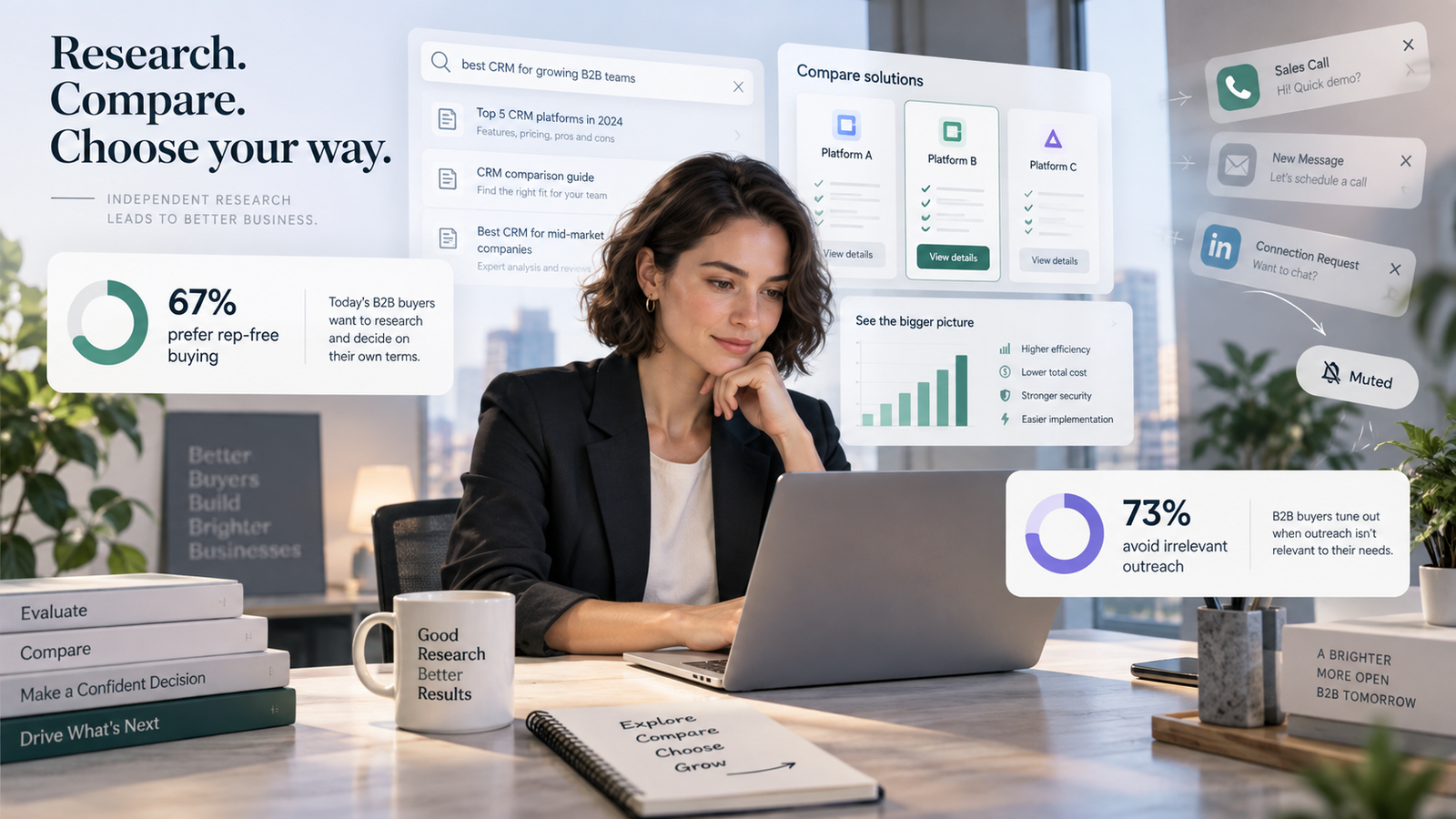
- Gartner’s research found 61% of B2B buyers prefer an overall rep-free buying experience - and a more recent Gartner survey found that number has since risen to 67%.
- These are two separate, consecutive Gartner survey waves finding the same underlying trend, not one figure being repeated - meaning this preference appears to be actively growing, not holding steady.
- Most buyers say they prefer to conduct independent research through digital channels rather than engage a sales rep directly, especially early in a purchase decision.
- The same Gartner research separately found that 73% of B2B buyers actively avoid suppliers who send them irrelevant outreach - a related, uncomfortable data point sitting alongside the rep-free preference finding.
- None of this means sales reps have become unnecessary - it means the moment and manner in which a rep engages a buyer now matters more than it used to, since buyers are actively opting out of rep contact by default.
The uncomfortable trend for anyone selling in B2B
Sales organizations tend to assume that better rep engagement is always the answer to a stalled buyer relationship - more responsive reps, better trained reps, reps who add more value in conversation.
Gartner’s own research complicates that assumption in a specific way: a growing majority of buyers say they’d simply rather not talk to a rep in the first place.
What the research found - twice
Gartner’s own sales research found that 61% of B2B buyers prefer an overall rep-free buying experience, based on a survey of 632 B2B buyers conducted in August and September 2024. A more recent Gartner survey found that figure has since risen to 67%.
These are two separate, sequential pieces of Gartner’s own published research, not the same number being recycled. Read together, they describe a trend moving in one direction: more buyers, not fewer, are choosing to avoid rep interaction over time.
Why buyers are opting out
The research points to a straightforward preference: most buyers would rather carry out independent research through digital channels than engage directly with a seller, particularly earlier in a purchase decision. This isn’t necessarily buyers rejecting the idea of ever talking to a person - it’s buyers choosing when and whether that conversation happens, rather than having it initiated for them.
This preference sits alongside a related, separately measured finding from the same body of research: 73% of B2B buyers actively avoid suppliers who send them irrelevant outreach. Put next to each other, these two findings describe buyers who are both increasingly choosing to self-serve and increasingly punishing sellers who interrupt that self-service with something that doesn’t feel relevant to them.
What this doesn’t mean
It would be easy to read “67% prefer rep-free” as “sales reps are becoming obsolete,” but that’s a bigger claim than the research actually supports. Buyers preferring to avoid unsolicited or premature rep contact is different from buyers never wanting to talk to a person about a purchase at all - particularly for complex, high-consideration B2B purchases, where some point of human judgment and reassurance often still matters.
What the research more precisely describes is a shift in when and how rep contact is welcome, not whether it’s ever welcome. A rep reaching out early, generically, and before a buyer has done their own research looks increasingly like exactly the kind of contact this same research says buyers now actively avoid.
The harder question this creates for outreach timing
If a majority of buyers prefer to self-serve early in their process and actively avoid irrelevant contact while doing so, outreach that arrives at the wrong moment risks being read as exactly the unwanted interruption this research describes - regardless of how good the underlying offer might genuinely be for that buyer.
This reframes a familiar outreach question. It’s not just “is this the right account and the right person” - it’s also “is this a moment where this specific buyer has indicated, in effect, that they don’t want to be reached this way.” Getting the account and the person right doesn’t fully solve the problem if the timing and channel are the actual source of the buyer’s resistance.
Frequently asked questions
Is the 67% figure a different survey than the 61% figure, or a correction?
They’re two separate, sequential Gartner surveys - the 61% figure came first, based on a 2024 survey of 632 buyers, and a more recent Gartner survey found the number had risen to 67%. This represents a real trend over time, not one number being restated.
Does this mean B2B sales reps are becoming unnecessary?
Not based on this research specifically. The findings describe a growing preference to avoid unsolicited or premature rep contact, which is different from buyers rejecting human interaction in a purchase process altogether.
Why might this preference be increasing?
The research doesn’t isolate a single cause, but it aligns with the related finding that a large majority of buyers actively avoid vendors who send irrelevant outreach - suggesting buyer patience for low-relevance rep contact may be declining broadly.
Does this finding apply equally across all types of B2B purchases?
The research is described at a general B2B buyer level rather than broken out extensively by deal complexity, so it’s reasonable to expect the preference is strongest for simpler or more standardized purchases and somewhat less absolute for highly complex ones.
What should this change about how outreach is timed?
The research suggests outreach that respects a buyer’s preference to self-serve early - rather than interrupting that process - is likely to be better received than contact that arrives before a buyer has had the chance to research independently.
Summary
Gartner’s own research found that 61% of B2B buyers prefer a rep-free buying experience in one survey wave, rising to 67% in a more recent one - a genuine trend, not a single repeated statistic. Buyers increasingly prefer to research independently through digital channels, particularly earlier in their purchase process, and the same research separately found that 73% actively avoid vendors who send irrelevant outreach. Together, these findings describe buyers who are both opting out of rep contact by default and penalizing sellers who interrupt that preference with low-relevance outreach - not a rejection of sales reps altogether, but a sharper standard for when and how their involvement is welcome.
Conclusion
A rising preference for rep-free buying doesn’t mean the sales conversation is disappearing - it means buyers are increasingly deciding for themselves when that conversation should start, and punishing sellers who try to force it earlier. For outreach specifically, this raises the bar past simply reaching the right person: the moment and manner of that contact now carries real weight in whether it’s welcomed or actively avoided.