
What Your Prospect Sees When They Check You Out First
Key takeaways
- 82% of buyers look up the sender on LinkedIn before replying to outreach - checking your profile is not the exception, it’s what most prospects do by default.
- Separately, 75% of B2B buyers say they use LinkedIn or social media to research a vendor before engaging with a sales team at all, confirming this isn’t a one-off finding from a single study.
- Most outreach advice focuses entirely on researching the prospect. Almost none of it addresses the fact that the research runs in both directions before a reply is ever sent.
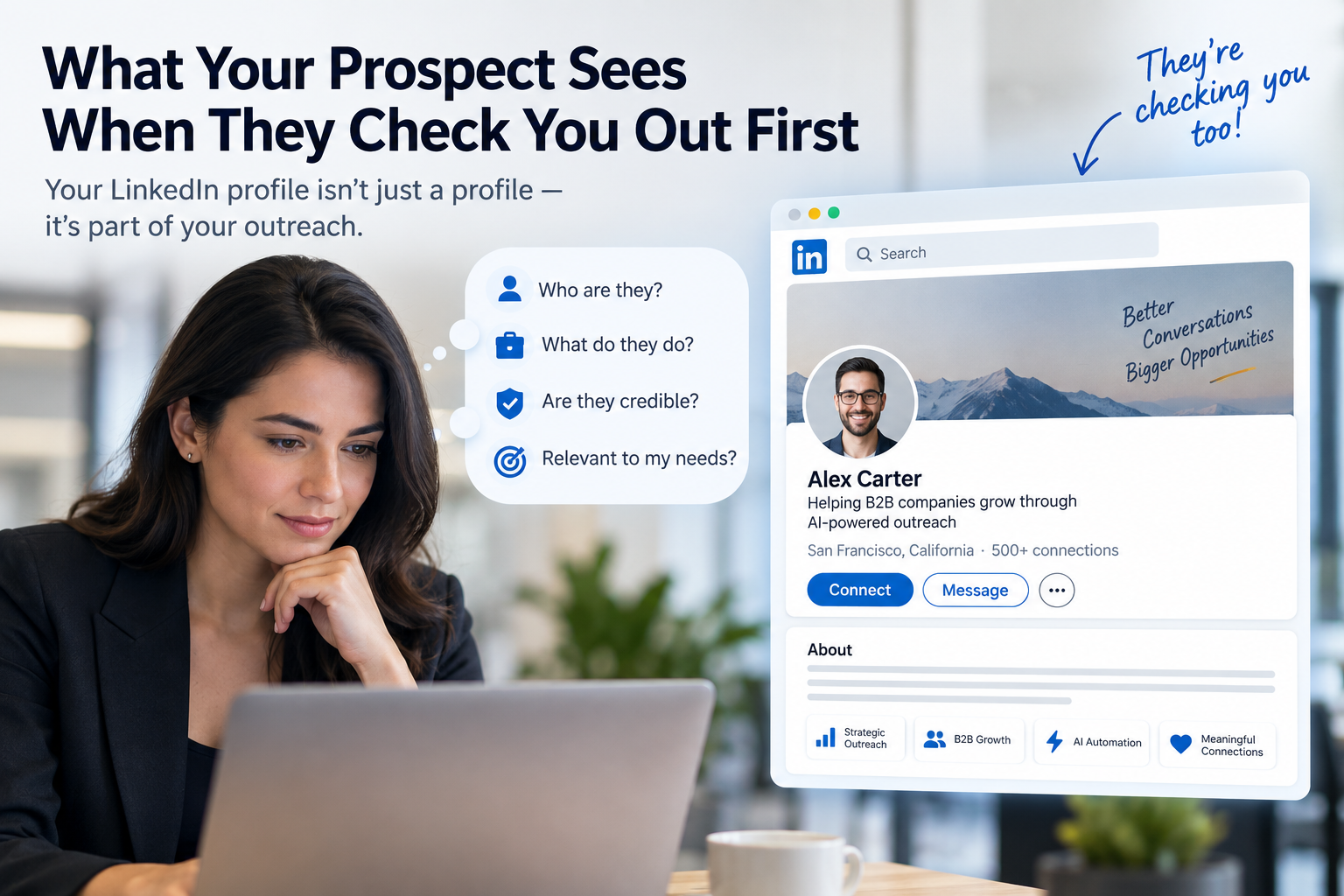
- Industry guidance converges on a “five-second test”: if a prospect can’t understand who you are, what you do, and why you’re credible within a few seconds of landing on your profile, outreach reads as an interruption rather than a relevant message.
- The bar rises further for senior and executive prospects - they receive more outreach than anyone else and have learned to quickly tell a researched message from a templated one, which extends to how they read the sender’s profile too.
- A well-researched message sent from a generic, resume-style profile is fighting itself - the research shows in the message, but the profile can undo the credibility that message was trying to build.
The research nobody accounts for
Almost everything written about outreach assumes the research only flows one way: you look up the prospect, learn about their company, and use that to write a relevant message. What that framing leaves out is what happens in the few seconds after your message actually lands.
Before a prospect decides whether to reply, a large majority of them do the same thing you did to them - they check you out.
The data: this isn’t a small edge case
According to industry research on sales prospecting behavior, 82% of buyers look up a provider on LinkedIn before replying to outreach. That figure alone would be worth taking seriously, but it isn’t an isolated finding - separate research puts the number at 75% of B2B buyers who say they use social media, primarily LinkedIn, to research a vendor before engaging with a sales team at all.
Different studies, different exact framing, but the same underlying behavior confirmed from two directions: checking out the sender before responding is the default, not something only cautious or senior buyers do.
What a prospect actually does in those few seconds
Guidance from multiple sources in the outreach space converges on a similar description of what happens when a prospect clicks through to a sender’s profile: they scan the headline, check how recently the person has been active, and form a fast judgment about whether this person looks credible, relevant to their situation, or safely ignorable.
One common framing calls this a five-second test: if a prospect lands on a profile and can’t tell, within a few seconds and without much scrolling, what market the sender operates in, what they actually do, and why they’re credible to talk about it, the message that got them there is already fighting an uphill battle - regardless of how well that message itself was written.
This means a genuinely well-researched, personalized message can still underperform if the profile behind it reads like a generic resume rather than something a prospect immediately understands the relevance of.
The bar is higher for the prospects who matter most
This effect isn’t evenly distributed across every type of prospect. Research on outreach to senior and C-suite targets specifically notes that these prospects receive a high volume of cold outreach and have learned to quickly distinguish a message that required real research from one written for a list.
It’s reasonable to expect the same discernment extends to how they evaluate a sender’s profile, not just the message itself - the more outreach someone receives, the faster and more critically they’re likely to size up whoever is sending it.
What this actually costs when it’s ignored
The practical risk here isn’t dramatic - nobody replies “your profile looked unconvincing.” It’s quieter than that: a prospect reads a well-personalized message, clicks through out of mild curiosity, sees a generic title-and-company profile with no recent activity, and simply doesn’t reply. The message did its job. The profile undid it.
This is a different failure mode than a poorly targeted list or a generic message - it’s entirely possible to do the qualification and personalization work correctly and still lose replies at this last, easily overlooked step.
What actually builds credibility in those few seconds
Based on the guidance converging across multiple sources, a handful of concrete things seem to matter most:
A headline that states what you do, not just your title. “VP of Sales” tells a prospect nothing about why the message is relevant to them. A headline framed around the problem solved gives them an immediate answer to “why is this person messaging me.”
An About section written around the prospect’s problem, not the sender’s résumé. The same principle applies here - a profile that reads like a CV signals “job seeker,” while one framed around a market and problem signals “specialist,” according to the outreach research above.
Recent, relevant activity. A profile with no posts or engagement in months reads as inactive or disposable, undermining even a well-written message landing in the same inbox.
Consistency between the message and the profile. If the message references specific expertise or a specific market, the profile should visibly back that up - mismatches between what a message claims and what a profile shows are exactly the kind of gap a prospect’s quick scan is designed to catch.
Frequently asked questions
Is it really true that most prospects check a sender’s profile before replying?
Yes - one figure puts it at 82% of buyers checking a provider on LinkedIn before replying to outreach, with separate research putting the broader vendor-research figure at 75%, from a different angle.
Does this matter more for some prospects than others?
Yes - research on outreach to senior and executive targets specifically notes they receive high volumes of outreach and have learned to quickly distinguish genuine research from templated messaging, which likely extends to how critically they assess a sender’s profile too.
Can a great message still fail because of a weak profile?
Based on the “five-second test” framing common in outreach guidance, yes - a prospect can be won over by a personalized message and then lose interest within seconds if the profile it came from doesn’t back up the credibility the message implied.
What’s the single fastest thing to check on a sending profile?
Whether the headline explains what problem you solve, rather than just stating a job title - this is the most commonly cited fix across the sources reviewed here.
Does this mean automation or scale is the problem?
Not directly - this is about sender profile credibility specifically, a separate issue from sending volume or personalization quality, and one that can undermine good work in either of those areas if left unaddressed.
Summary
Outreach research almost always focuses on the prospect side of the equation, but the data shows the research runs both ways: a large majority of buyers - 82% in one study, 75% in another - check out the sender before deciding whether to reply at all. What they’re looking for in those few seconds is described consistently across multiple sources as a fast credibility check: does the headline explain relevance, does the profile look active, does it back up whatever the message claimed. This bar is especially high for senior and executive prospects, who receive the most outreach and have the most practice spotting a mismatch between a researched message and a generic profile. The practical risk is that even well-qualified, well-personalized outreach can quietly underperform if the sender’s own profile doesn’t hold up to the same scrutiny being put into the message.
Conclusion
Most of the effort in good outreach goes into researching the right prospect and writing a message that reflects it - and that effort is real and necessary. But the data suggests it isn’t sufficient on its own, because the prospect is very likely doing their own version of that research on the sender, in the few seconds before deciding whether to reply at all. A message can pass every internal quality bar and still lose the reply at that last, quiet step. Treating the sender’s own profile as part of the outreach - not a fixed detail to set up once and forget - closes a gap that most outreach advice never mentions.